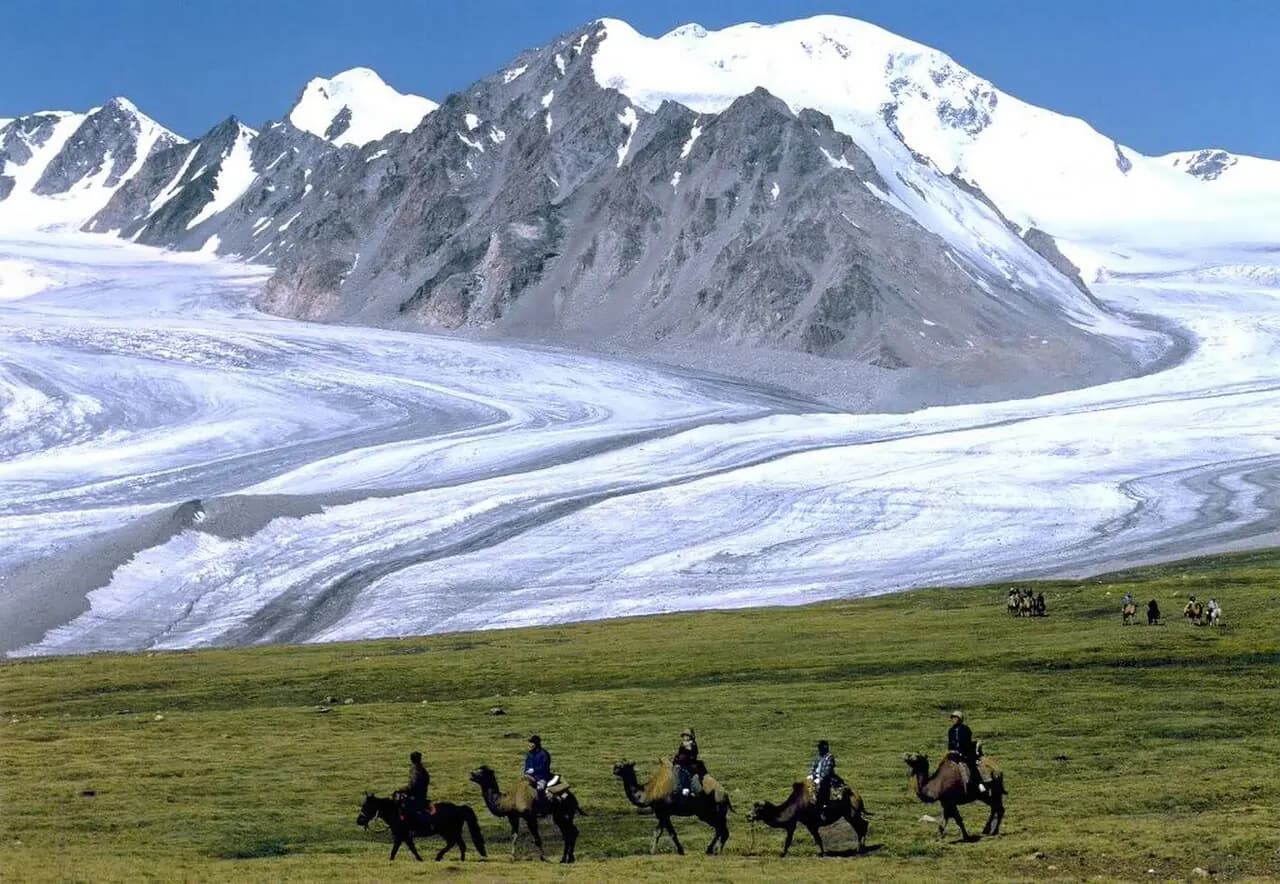
Mongolia's highest peak Khüiten (4,374 m) and the Potanin glacier.
Altai Tavan Bogd National Park covers about 6,362 km² in the far west of Bayan-Ölgii, where Mongolia meets Russia and China. Its centrepiece is the Tavan Bogd ('Five Saints') massif, crowned by Khüiten Peak, at 4,374 m the highest point in the country. Below the peaks lie glaciers, wide valleys grazed by Kazakh herders and a chain of long lakes, Khoton, Khurgan and Dayan. The park was created in 1996, and its rock art is part of a UNESCO World Heritage Site. A border-zone permit is required.
Glaciers and high valleys
The Potanin glacier, flowing from the Tavan Bogd peaks, is about 14 km long and the longest in Mongolia. It is shrinking: it retreated about 90 m between 2003 and 2009, and its lower part thinned by more than 2 m a year. Lower down, the valleys are open alpine meadows and steppe, and larch forest grows along parts of the lakes. Wildlife includes argali, ibex, red deer, moose, snow leopard, Altai snowcock and golden eagle.
Trekking in the park
The usual trip is a trek from the lakes or the road head towards Tavan Bogd, with camels or horses carrying the loads, followed by a day walk onto the glacier moraine from the base camp. Malchin Peak can be climbed without technical gear, but Khüiten needs ropes, crampons and mountaineering experience. Plan on at least a week in the park, including travel from Ölgii.
Season, altitude and safety
The short season runs from late June to early September. Even then, snow and freezing nights are possible. Altitude affects many people above 3,000 m, so ascend gradually and drink plenty of water. Never cross a glacier without a guide and rope, since crevasses can be hidden under snow. Ask before photographing families or their eagles, and leave petroglyphs and burial mounds untouched.
Photo: Altaihunters · CC BY-SA 3.0 · Wikimedia Commons
History
The history of Altai Tavan Bogd
Rock art across 12,000 years
The valleys of the Mongolian Altai hold some of the richest rock art in Asia. Three sites here are a UNESCO World Heritage Site, the Petroglyphic Complexes of the Mongolian Altai (2011): Tsagaan Salaa and Baga Oigor, Upper Tsagaan Gol and Aral Tolgoi. Thousands of carvings show mammoths and wild animals from the end of the Ice Age, then hunters, chariots, herds and riders as people turned to herding.
Burial mounds and stone figures
The valleys are dotted with deer stones, Bronze Age burial mounds and Turkic stone statues from the 6th to 8th centuries. In 2006 a Mongolian, German and Russian team found the frozen grave of a Scythian-era warrior, about 2,500 years old, preserved in the permafrost with his clothes, weapons and horses.
The Kazakh eagle hunters
Kazakh families began moving into the Altai in the mid-19th century, and today they make up most of Bayan-Ölgii province. They brought the tradition of hunting with golden eagles, which is celebrated every autumn at the Golden Eagle Festival. The national park was created in 1996.
Things to do at Altai Tavan Bogd
5 activities · best season: Summer
Hiking · 1 day
Trek to the Potanin Glacier
From the base camp below Tavan Bogd, a day walk leads onto the moraine of Mongolia's largest glacier.
Read the guide →Climbing · 1 day
Climb Malchin Peak
At 4,050 m this summit needs no technical gear and gives views into Mongolia, Russia and China. Khüiten Peak itself needs mountaineering experience.
Culture · 1–3 days
Meet Kazakh eagle hunters
Stay with Kazakh families who still hunt with golden eagles, or see them compete at the Golden Eagle Festival in Ölgii in October.
Read the guide →History · Half day
Find ancient rock art
The petroglyphs of Tsagaan Salaa and Baga Oigor, a UNESCO World Heritage Site, cover thousands of years of hunting and herding scenes.
Boating · 1–2 days
Camp and kayak at Khoton and Khurgan lakes
The long lakes inside the park are calm in summer and good for paddling, fishing and camping.
When to go & how to get there
Weather by month
Getting there
Fly from Ulaanbaatar to Ölgii, the capital of Bayan-Ölgii. From Ölgii it is about 6–8 hours by 4x4 to the park. You need a border-zone permit, usually arranged through a tour company or in Ölgii, and a guide is strongly advised.
Where to stay
Ölgii has hotels and guesthouses. In the park, stays are in tents, at the ranger station area or with Kazakh herding families in their gers in summer.
Gallery
5 photos · tap to enlarge · sources credited on each photo
Where is Altai Tavan Bogd?
from Ulaanbaatar from Ölgii · a dotted end marks a stretch with no road
Bayan-Ölgii province · nearest town: Tsengel soum
Guides that mention Altai Tavan Bogd
- Mongolian GeographyMongolian geography explained: the Altai, Khangai and Khentii ranges, Lake Khövsgöl, rivers, steppe, the Gobi Desert, the extreme climate and travel tips.
- Wildlife of MongoliaWildlife of Mongolia: snow leopards, Przewalski's horses, wild camels, Gobi bears, gazelles, eagles and taimen, plus where to see them responsibly.
- Tourism in MongoliaTourism in Mongolia explained: top regions from the Gobi to Khövsgöl and the Altai, the travel season, transport, ger camps and how trips are usually organised.
- Mongolia Tourism OrganizationsMongolia tourism organizations explained: the ministry in charge of tourism, the Mongolian Tourism Association, park administrations and border agencies.
- Mongolia Weather & ClimateMongolia weather and climate by season and region: temperatures, rain and wind in Ulaanbaatar, the Gobi, the north, the Altai and the eastern steppe.
- Mongolia on the World MapWhere is Mongolia on the world map? A landlocked country between Russia and China: borders, latitude and longitude, size and comparisons with other countries.
Western Mongolia
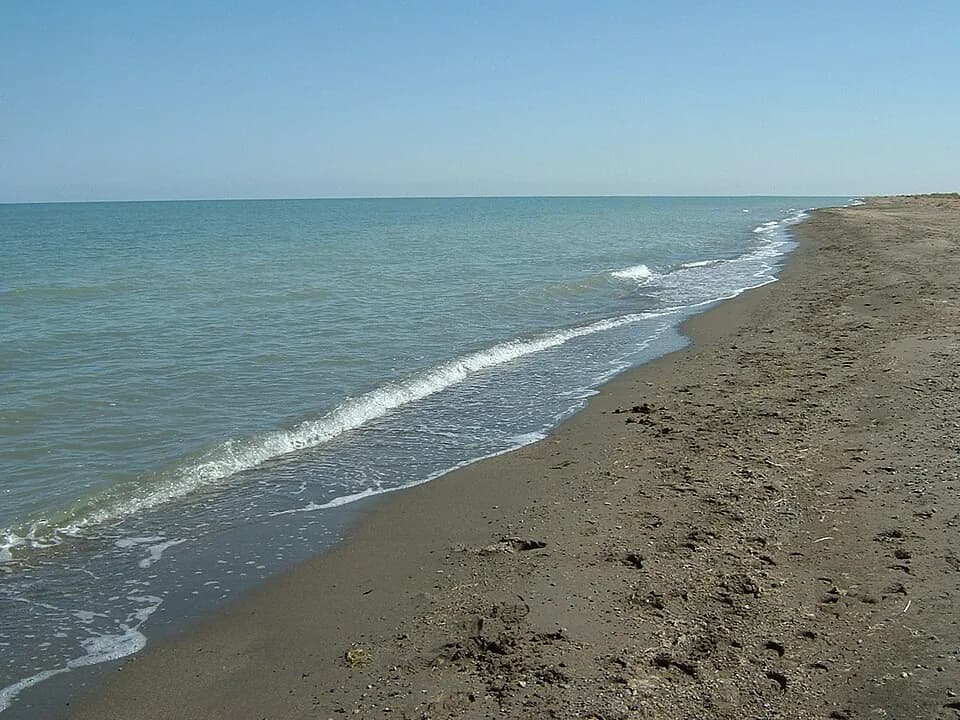
Uvs Lake
Mongolia's largest lake, a UNESCO biosphere reserve.
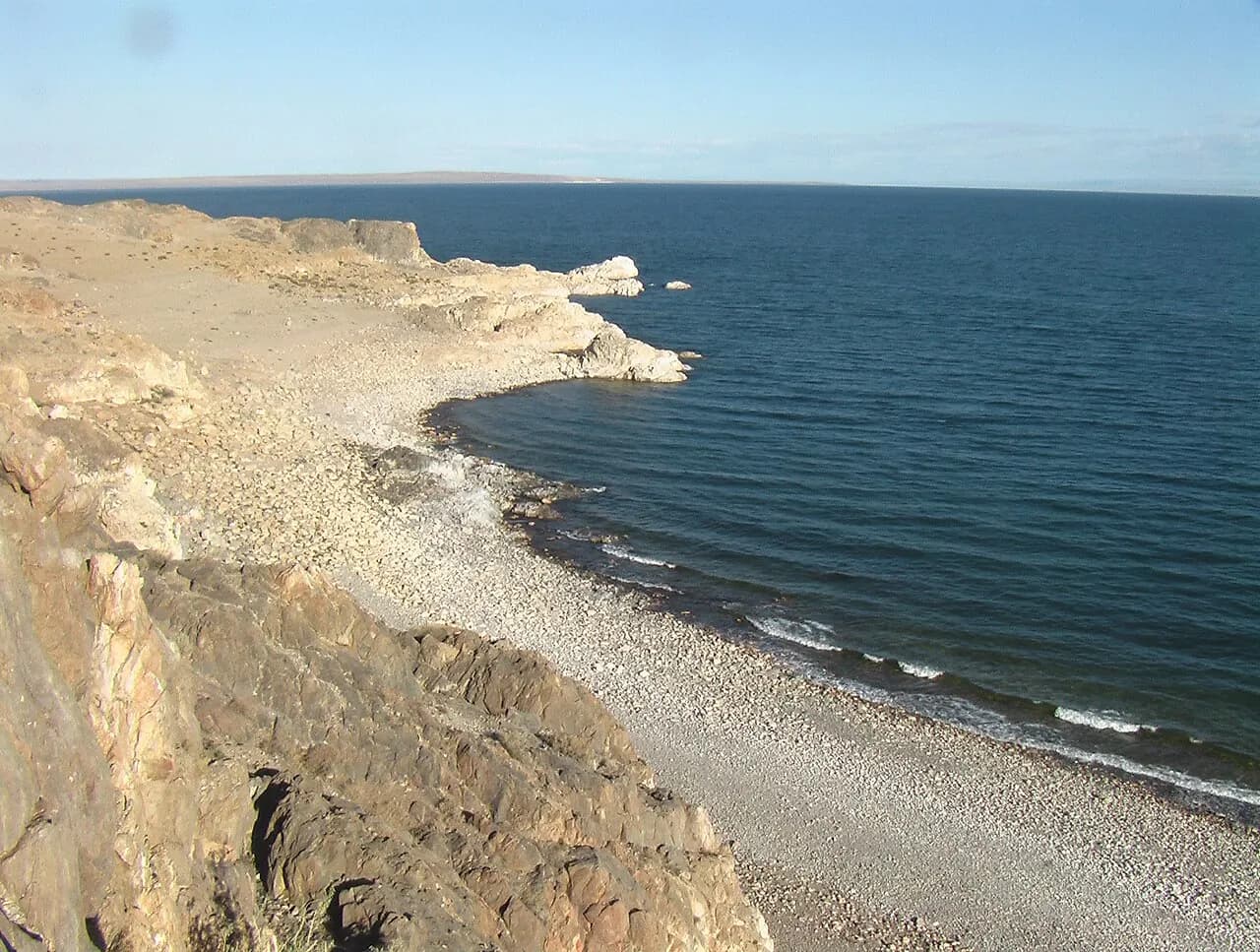
Khyargas Lake & Khetsüü Khad
A sea-like lake in the desert, with a cliff colony of cormorants.
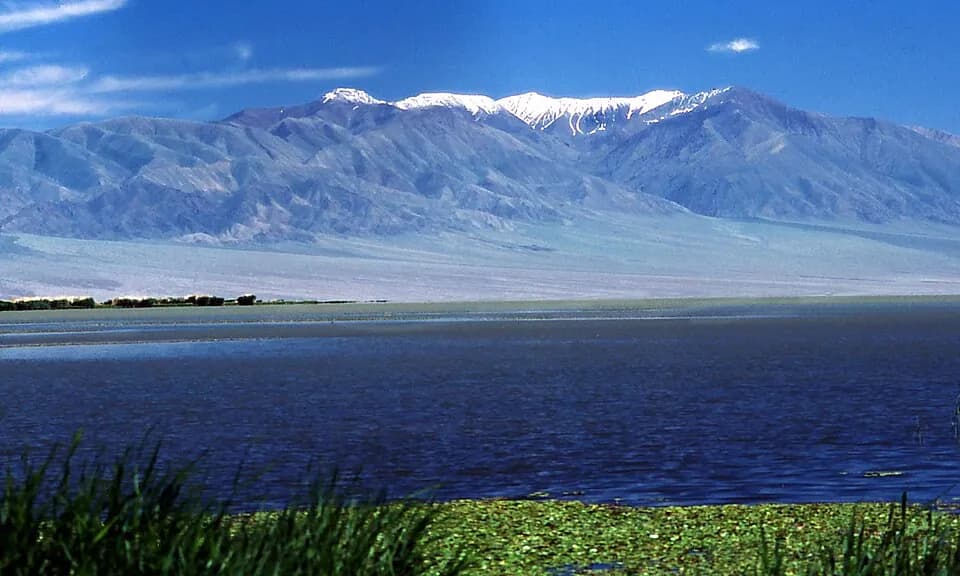
Khar Us Nuur National Park
A vast, shallow freshwater lake and reed-fringed delta east of Khovd, protected for its migratory birds.