Photo: Satdeep Gill · CC BY-SA 4.0 · Wikimedia Commons
Ceremonial dishes
Uuts (the ceremonial back)
The whole sheep's back set out as the centrepiece of Tsagaan Sar.
What it is
Uuts is the boiled back of a sheep, including the broad fatty tail and sometimes the head, set out whole as the centrepiece of the Tsagaan Sar table. It is more than a large joint of meat. A plump back and a thick tail show that the household's animals came through the winter in good condition, so families look for the largest, fattest-tailed sheep they can find: the fatter the tail, the more good fortune it is said to promise for the year ahead. Uuts also appears at other major feasts, including weddings.
How it is prepared and displayed
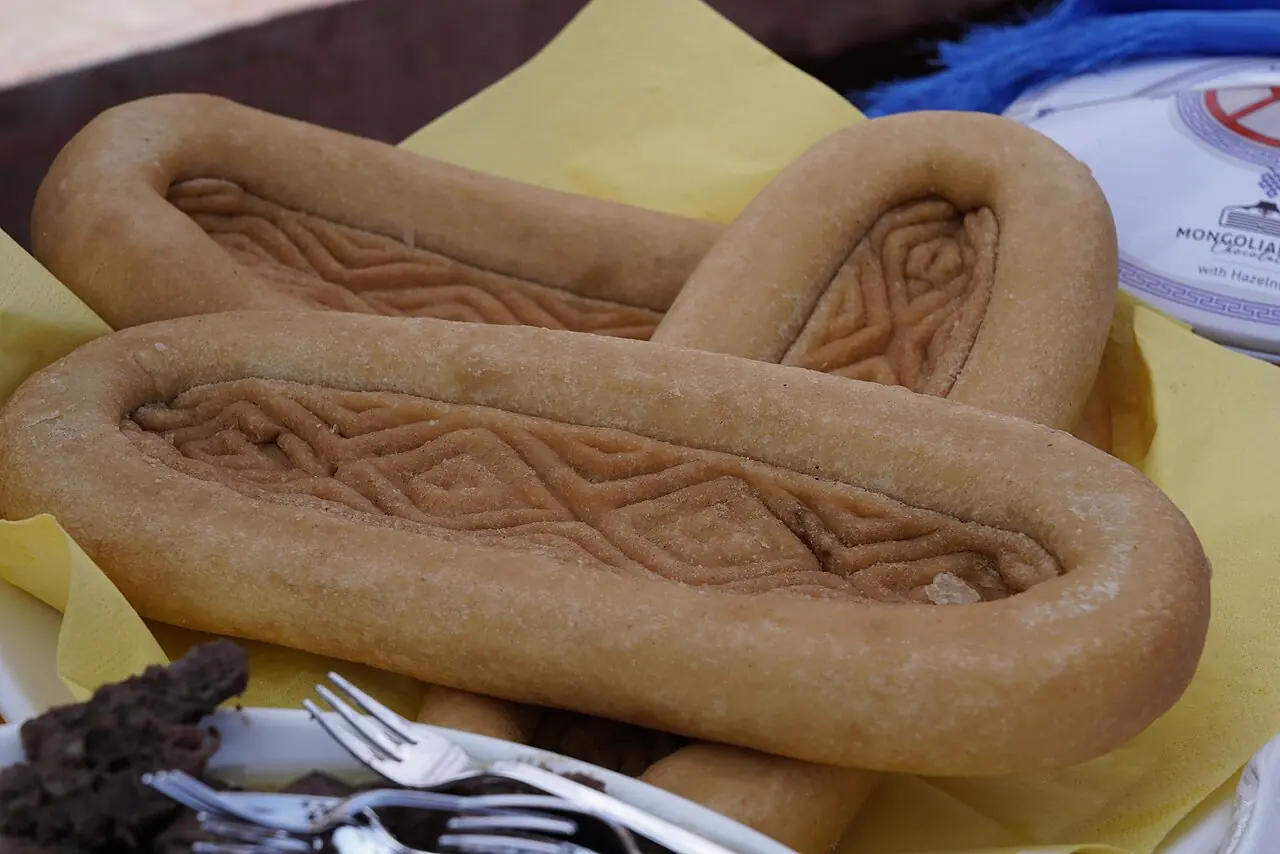
The back is boiled whole in salted water for two to three hours, usually a few days before the holiday, and then kept outside in the cold, which acts as a natural refrigerator in a Mongolian February. On the table it is laid with the tail at one end and usually sits beside, or near, the ul boov: a tower of flat "shoe-sole" biscuits stacked in odd-numbered layers. Younger households often build three layers, middle-aged couples five, and families with elders in their seventies seven or nine. The tower is decorated with aaruul, sugar cubes, sweets and other white foods.
On Bituun, the eve of the new year, the head of the household cuts the first slices and offers them to the fire and the sky before the family eats. For the rest of the holiday the uuts stays on the table, returning to the cold between meals, and the host carves thin slices for each visitor.
When and where to try it
Uuts is a winter festival dish, tied almost entirely to Tsagaan Sar, which falls between late January and early March depending on the lunar calendar. You will not find it on restaurant menus in the ordinary way. The best chance to see it is as a guest in a Mongolian home during the holiday. Even if you do not eat much fat, it is worth seeing how the table is arranged, because each element of it carries meaning.
Etiquette and tips
- Do not carve the uuts yourself. Wait for the host to cut a slice and hand it to you, and receive it with your right hand or both hands.
- A slice that includes some tail fat is a mark of hospitality. Eat a small piece; you are not expected to finish a large portion.
- Take biscuits and dairy from the top of the ul boov only when invited, and start with a little.
- Tsagaan Sar visits involve several homes over several days, so pace yourself at each table.
- Ingredients
- Sheep back, salt
- How it is made
- Boil the whole back 2 to 3 hours and dress the table.
- Health & season
- A winter festival dish. · Winter
- Famous in
- Central, Khangai & Central, Eastern Mongolia, Gobi, Western Mongolia
Photo: Satdeep Gill · CC BY-SA 4.0 · Wikimedia Commons
Where to eat real Mongolian food in Ulaanbaatar