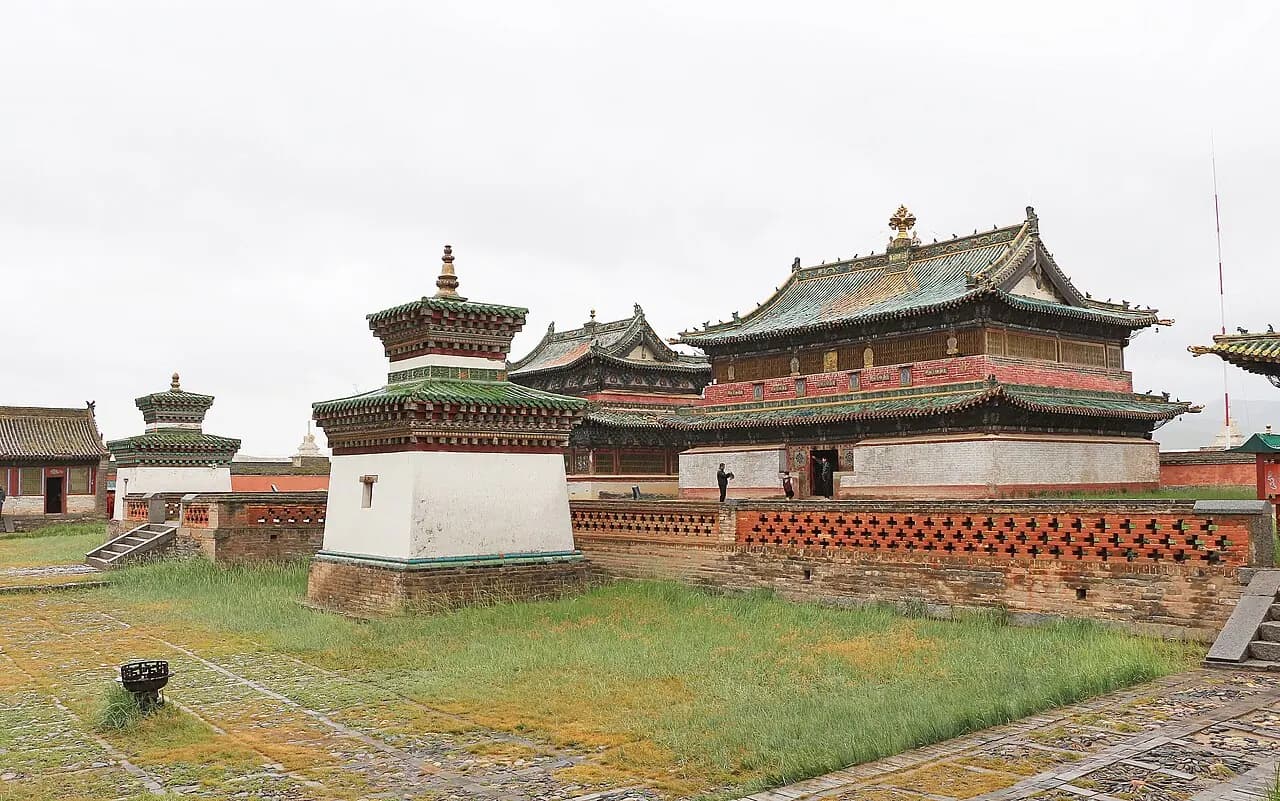
Mongolia's oldest surviving Buddhist monastery, built on the ruins of the imperial capital Karakorum.
Kharkhorin is a small town in the upper Orkhon valley, built beside the site of Karakorum, the 13th-century capital of the Mongol Empire. Its main sight is Erdene Zuu, founded in 1585 by Abtai Sain Khan partly with stones from the ruined city and famous for its wall lined with white stupas. The Kharakhorum Museum displays finds from the imperial capital, and the whole area belongs to the Orkhon Valley Cultural Landscape, a UNESCO World Heritage Site covering almost 122,000 hectares.
What you see at Erdene Zuu
The monastery sits inside a square enclosure roughly 400 m on each side. The wall was planned to carry 108 stupas, a sacred Buddhist number. Inside, most of the ground is open grass where temples once stood. The surviving buildings include three temples known as the Zuu, which have Chinese-style green-tiled roofs and painted interiors with statues of the Buddha, and the Tibetan-style Lavrin temple, where monks hold prayers in the morning.
The town and the valley
Around town, the two granite stone turtles that once marked the edges of Karakorum still sit in the fields, and on a hill outside the monastery stands a stone phallus, said to keep the monks' thoughts in order. The Orkhon river flows by on its way north, through pastures dotted with herders' gers.
How long and when
Half a day covers the monastery and museum; a full day lets you add the turtles and the hilltop monument. Kharkhorin can be visited all year, but June to September is warmest, with most rain falling in July. Dress modestly in the temples, walk clockwise around stupas and prayer wheels, keep your voice low during prayers, and ask before taking photographs inside, as photography is restricted in some temples.
Photo: Bernard Gagnon · CC0 · Wikimedia Commons
History
The history of Kharkhorin & Erdene Zuu
Capital of the Mongol Empire
In 1220 Chinggis Khaan chose this spot in the Orkhon valley as the base of his empire. His son Ögedei Khan built a walled city here in 1235, with a palace and quarters for merchants and craftsmen from across Eurasia. For about thirty years Karakorum was the capital of the largest land empire in history.
Envoys, monks and traders came from Europe, Persia and China. The Flemish friar William of Rubruck, who visited in 1254, described Christian, Muslim and Buddhist places of worship side by side, and a famous silver fountain shaped like a tree, made by a Parisian goldsmith, that poured wine, mare's milk, mead and rice wine.
Decline
When Khubilai Khan moved the capital to Khanbaliq (today's Beijing) in the 1260s, Karakorum lost its role. After the fall of the Yuan dynasty it was sacked by Ming armies in the late 14th century and slowly disappeared under the steppe.
Erdene Zuu Monastery
In 1585 Abtai Sain Khan founded Erdene Zuu, the first major Buddhist monastery in Mongolia, partly from the stones of the ruined city. Its wall is crowned by 108 white stupas. During the purges of 1937 most of its temples were destroyed and the monks killed or sent away; three temples survived as a museum. Erdene Zuu was returned to the lamas in 1990 and is an active monastery again.
Today
Kharkhorin is part of the Orkhon Valley Cultural Landscape, a UNESCO World Heritage Site since 2004. The Kharakhorum Museum shows finds from the old capital, and two stone turtles that once guarded the city still stand in the fields.
Things to do at Kharkhorin & Erdene Zuu
4 activities · best season: Summer, Autumn, Spring, Winter
Culture · 2 h
Tour Erdene Zuu Monastery
Walk inside the stupa-lined outer wall, visit the three old temples and, in the morning, listen to the monks chanting in the Lavrin temple.
Museum · 1–2 h
See the Kharakhorum Museum
Finds from the imperial capital, a scale model of the 13th-century city and pieces from the Turkic and Uyghur eras.
History · 30 min
Find the stone turtles
Two of the granite turtles that once marked the boundaries of Karakorum still sit in the fields near the monastery.
Photography · 1 h
Climb to the Mongol Empire monument
The hilltop monument above town shows maps of the great empires of the steppe and gives a view over the Orkhon valley.
When to go & how to get there
Weather by month
Getting there
Kharkhorin is linked to Ulaanbaatar by a paved road (about 6–7 hours by car). Daily buses leave Ulaanbaatar's Dragon bus station; shared minivans also run. The small airfield has no scheduled flights.
Where to stay
The town has guesthouses and small hotels, and several ger camps lie along the Orkhon river just outside town. It is a good base for trips into the Orkhon valley.
Gallery
5 photos · tap to enlarge · sources credited on each photo
Where is Kharkhorin & Erdene Zuu?
from Ulaanbaatar from Arvaikheer · a dotted end marks a stretch with no road
Övörkhangai province · nearest town: Kharkhorin
Guides that mention Kharkhorin & Erdene Zuu
- A Brief History of MongoliaA brief history of Mongolia from the Xiongnu of 209 BC through Chinggis Khaan, Qing rule, 1911 independence and socialism to the 1990 democratic revolution.
- Mongol EmpireThe Mongol Empire, history's largest contiguous land empire: its rise under Chinggis Khaan, expansion, governance, its division and where to see its traces.
- Kublai Khan / Хубилай хаанKublai Khan, Chinggis Khaan's grandson and founder of the Yuan dynasty: his rise, Khanbaliq and Xanadu, the Japan invasions, Marco Polo and his legacy.
- Religion in MongoliaReligion in Mongolia: an overview of Buddhism, shamanism and Tengrism, Islam among Kazakhs, Christianity, religious freedom and how to visit sacred sites.
- Tourism in MongoliaTourism in Mongolia explained: top regions from the Gobi to Khövsgöl and the Altai, the travel season, transport, ger camps and how trips are usually organised.
- Best Time to Visit MongoliaThe best time to visit Mongolia is June to September, with warm days, green steppe and Naadam. See what each season offers, from spring to winter festivals.
Khangai & Central
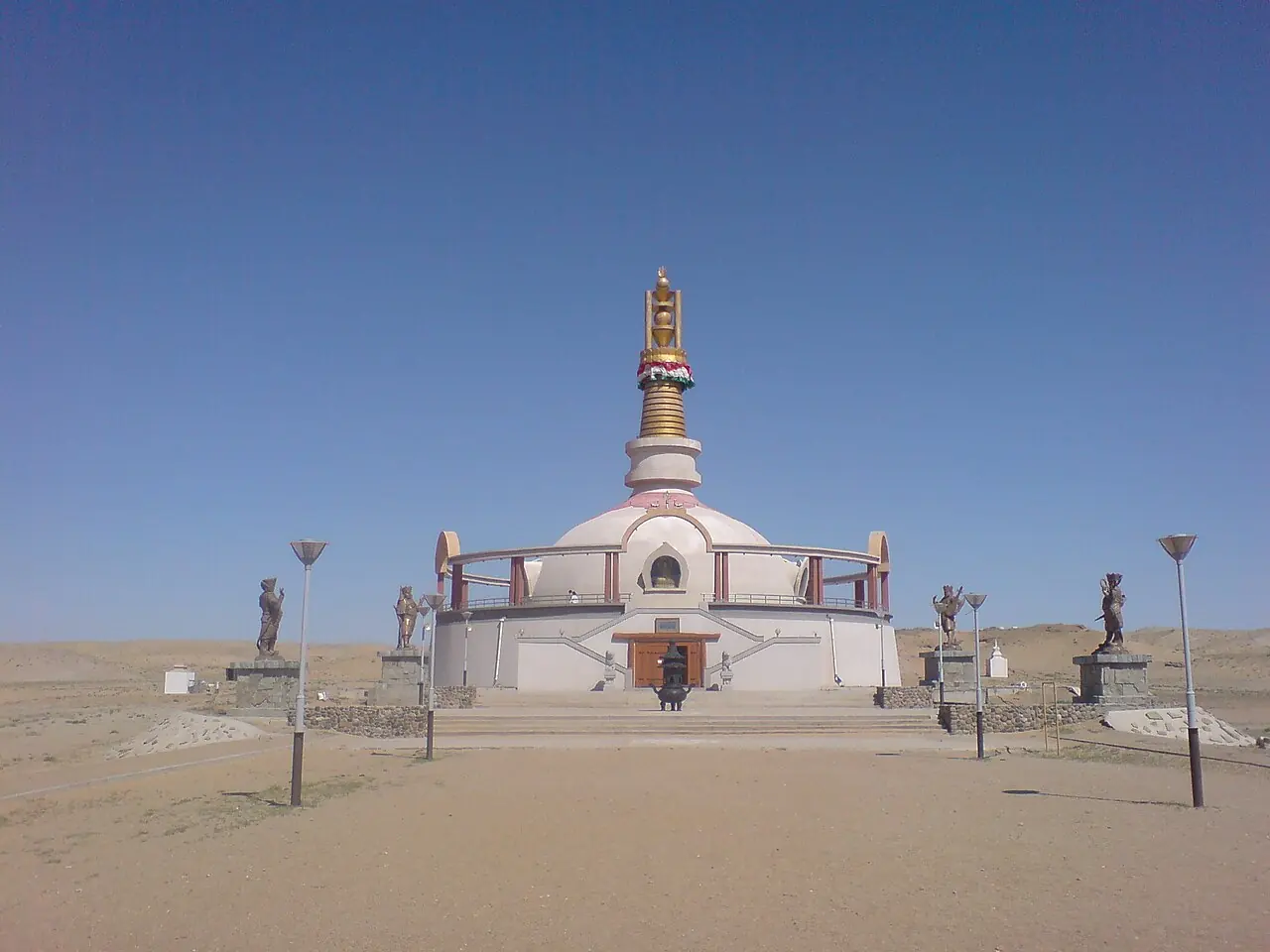
Khögnö Khan & Elsen Tasarkhai
Gobi, steppe and mountain in one place; the closest dunes to the capital.
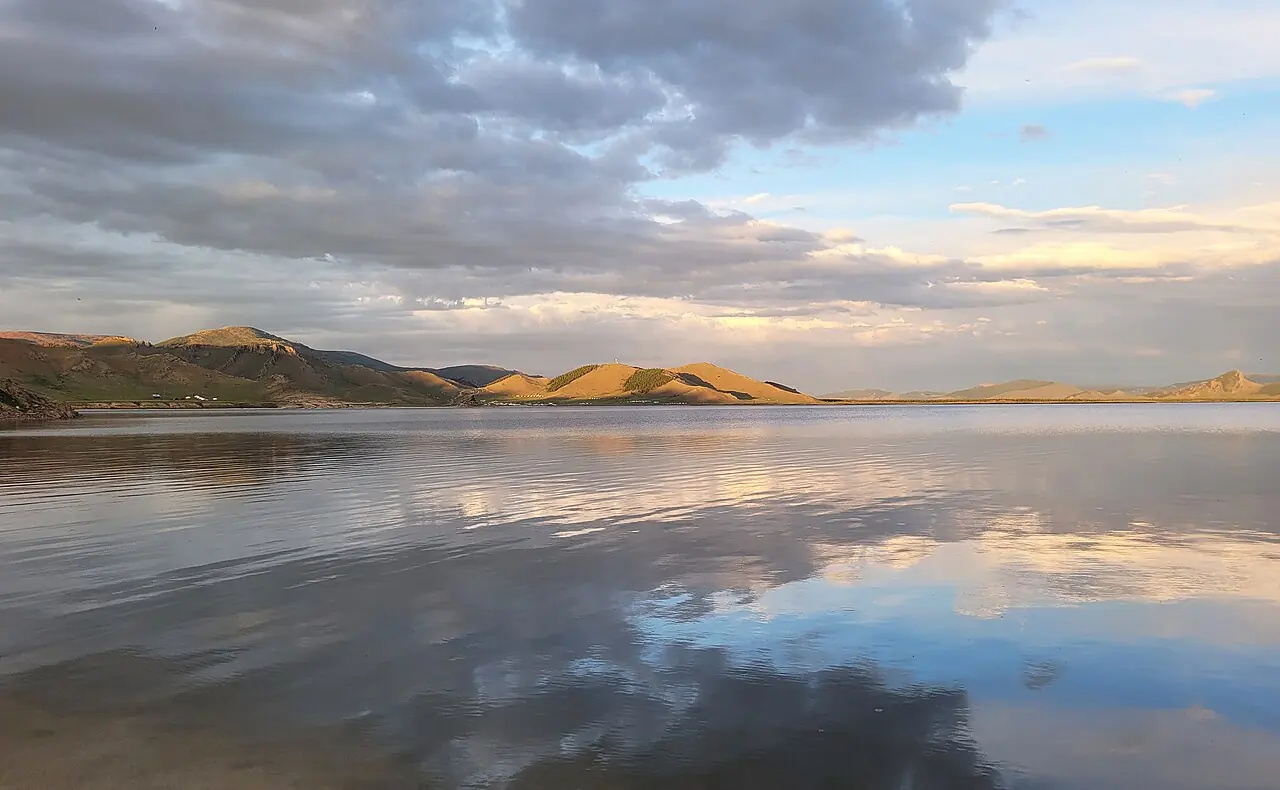
Terkhiin Tsagaan Lake & Khorgo
A freshwater lake beside an extinct volcano.
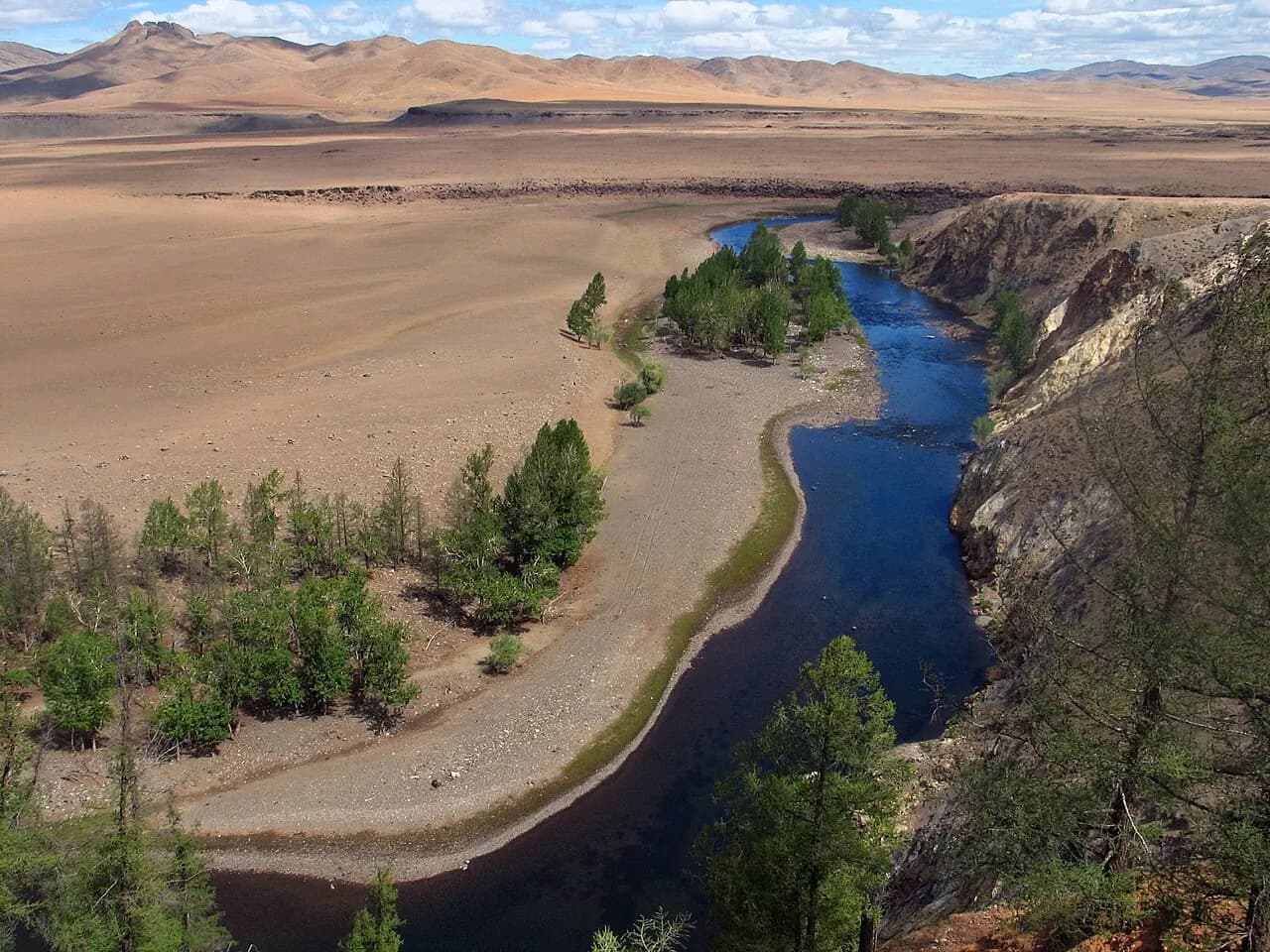
Orkhon Valley & Ulaan Tsutgalan
A 20 m waterfall, nomad summer camps and Tövkhön monastery.