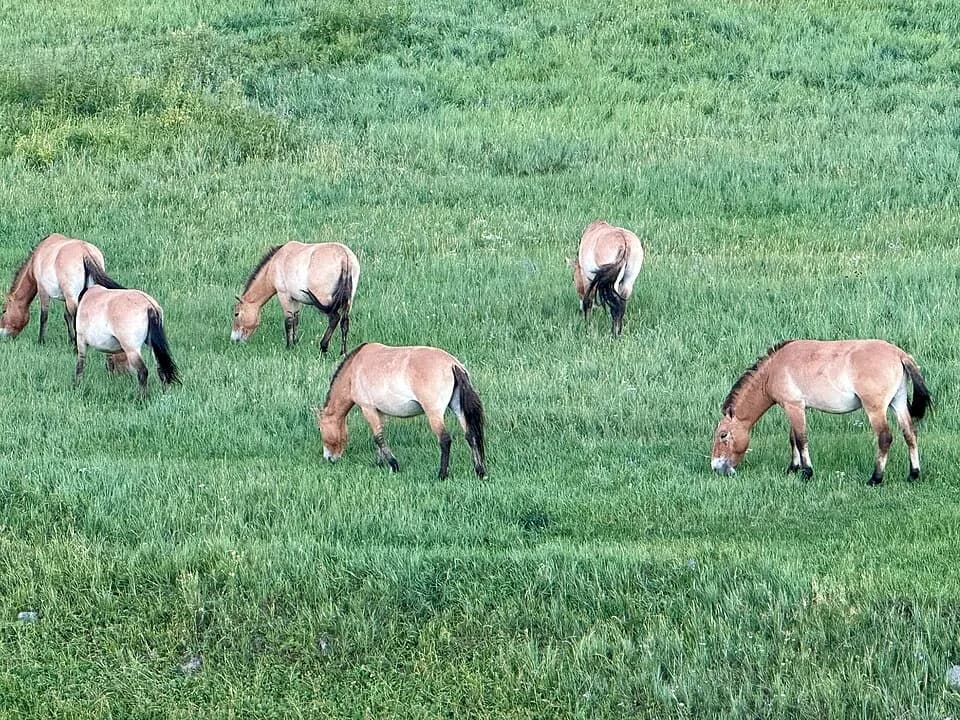
Steppe and birch-covered hills west of Ulaanbaatar where wild takhi horses were returned to Mongolia.
Khustai National Park (Khustain Nuruu, the 'birch range') protects about 506 km² of steppe and low mountains roughly 100 km west of Ulaanbaatar, on the south-western spurs of the Khentii ranges. It is best known as the place where the takhi, or Przewalski's horse, was returned to Mongolia from 1992. A count in 2021 found 380 takhi in the park, and the herd now numbers around 400. Khustai is also a UNESCO biosphere reserve and an Important Bird Area.
Landscape and wildlife
The park is mountain forest steppe: rolling grassland and rocky ridges, with birch woods in the side valleys, and the Tuul River and its floodplain along the southern edge. The 2.5 km Moltsog Els sand dunes in Argalant soum are also protected. The climate is dry, with about 270 mm of rain a year, most of it falling between May and September. Besides the takhi there are around 500 red deer, Mongolian gazelles, argali, Siberian ibex, wolves, lynx, Pallas's cats and tens of thousands of marmots. Researchers have recorded 459 vascular plant species and more than 200 bird species.
Seeing the takhi
Takhi are stocky, dun-coloured horses with a pale muzzle and a short, upright dark mane. They live in harems of one stallion with several mares and their foals, while young males form bachelor groups. Bring binoculars: you watch them from a distance and follow the rangers' instructions on how close vehicles may go.
When to go
May to September is the main season. Foals are born in late spring and early summer, July and August are the greenest and wettest months, and in September and early October red deer stags call during the rut. One night is the minimum to see the takhi at dusk and dawn; two allow time for walking.
Photo: Josep Renalias Lohen11 · CC BY 4.0 · Wikimedia Commons
History
The history of Khustai National Park
Return of the takhi
The takhi, or Przewalski's horse, was described by science in 1881 and had disappeared from the wild by 1969, surviving only in zoos and breeding centres abroad. In 1992 the Dutch Foundation for the Preservation and Protection of the Przewalski Horse (FRPH) and the Mongolian Association for the Conservation of Nature and the Environment (MACNE) began returning captive-bred horses to the Khustai hills. The first 16 horses were released on 5 June 1992, World Environment Day. Further groups followed every two years, and by 2000 a total of 84 horses had been brought in. The herd has since grown to several hundred animals living in harems and bachelor groups.
Protection
The area was declared a protected area in 1993 and given national park status in 1998. UNESCO's Man and the Biosphere programme recognised it as a biosphere reserve in 2002. Since 2003 the park has been run by the Hustai National Park Trust, a non-governmental body that funds conservation partly from tourism.
Older monuments
The park also holds much older remains. Its Turkic-period memorial complex (6th to 7th century) includes stone figures of a lion and a sheep and a line of 552 balbal stones. There is a deer stone in the Khuurai valley and more than 160 rectangular graves from the Bronze Age.
Things to do at Khustai National Park
5 activities · best season: Spring, Summer, Autumn
Wildlife · 2–3 h
Watch the takhi
Drive the park tracks with a ranger or guide to find takhi harems. The horses spend the day higher in the hills and often come down towards water in the evening, so dusk and early morning give the best chances.
Hiking · 2–4 h
Walk the hills
Walk up through the steppe and birch slopes that give the park its name (khus means birch) for views over the valleys. Stay on marked routes and keep your distance from the horses.
Read the guide →History · 1–2 h
See the Turkic monuments
Visit the Turkic-era memorial with its stone lion and sheep and long line of balbal stones, plus Bronze Age graves and a deer stone elsewhere in the park.
Birdwatching · 1–2 h
Look for raptors and steppe birds
More than 200 bird species have been recorded, including golden eagle, lammergeier, black stork and Daurian partridge.
Museum · 30 min
Visitor centre
The visitor centre at the park headquarters explains the takhi reintroduction and the park's wildlife.
When to go & how to get there
Weather by month
Getting there
Khustai lies about 100 km west of Ulaanbaatar. Drive west on the paved highway towards Kharkhorin and turn off to the park headquarters; the trip takes around 1.5–2 hours by car. Most visitors come by private car or with a tour, as there is no regular public bus to the park.
Where to stay
The park runs a ger camp next to the headquarters and visitor centre, and there are other tourist camps nearby. Khustai is close enough to Ulaanbaatar for a day trip, but staying overnight lets you look for the takhi in the evening and early morning.
Gallery
4 photos · tap to enlarge · sources credited on each photo
Where is Khustai National Park?
from Ulaanbaatar from Zuunmod · a dotted end marks a stretch with no road
Töv province · nearest town: Argalant soum
Guides that mention Khustai National Park
- Mongolia Travel MapMongolia travel map explained: the Gobi, Central Khangai, Khövsgöl in the north, the western Altai and the eastern steppe, with classic routes from Ulaanbaatar.
- Things to Do & See in UlaanbaatarThings to do in Ulaanbaatar: Gandan Monastery, Sükhbaatar Square, the National Museum, Bogd Khan Palace, Zaisan, Choijin Lama Temple and folk shows.
Central
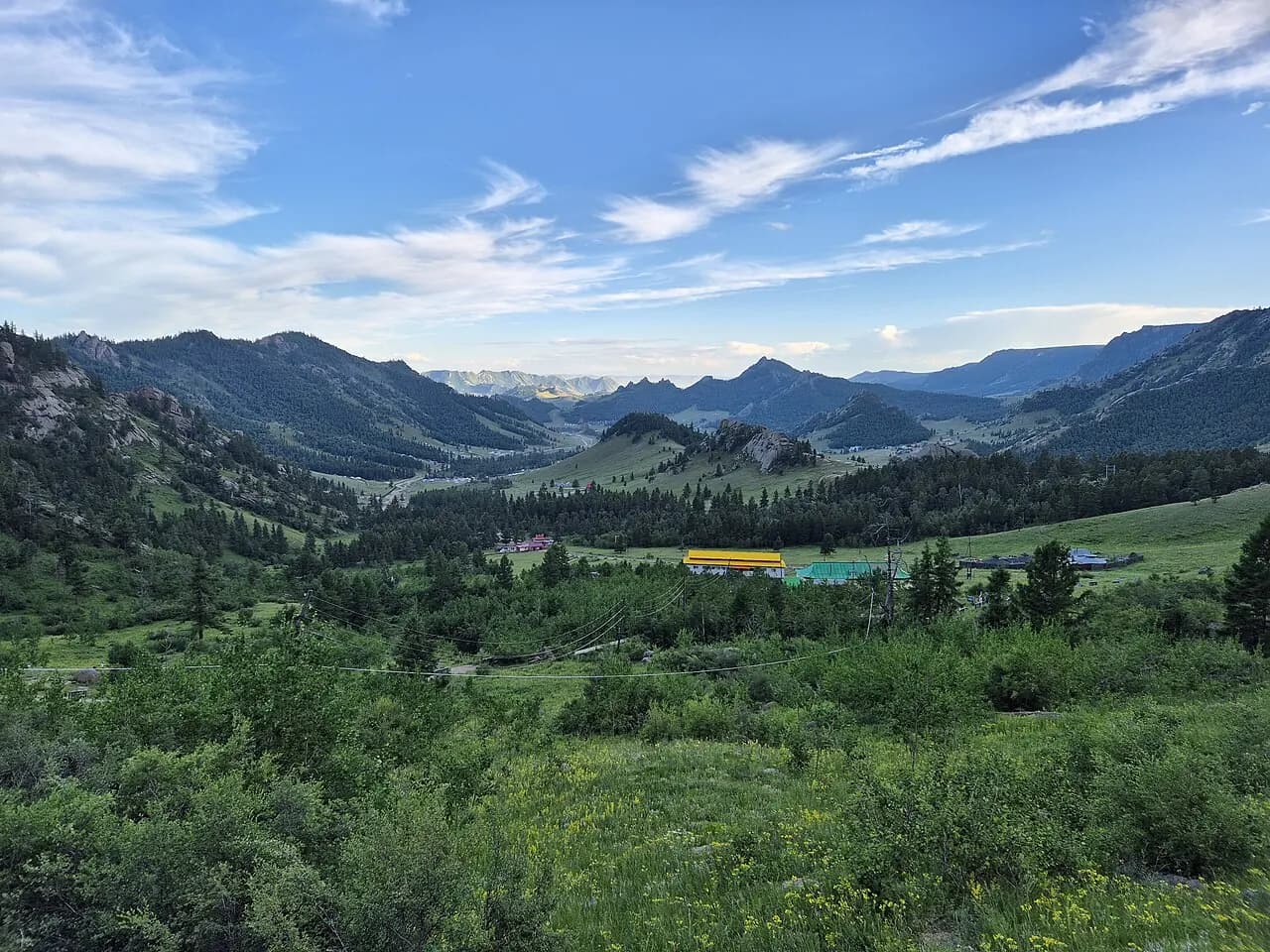
Gorkhi-Terelj
Rocks, forests and ger camps 1.5 hours from the capital.
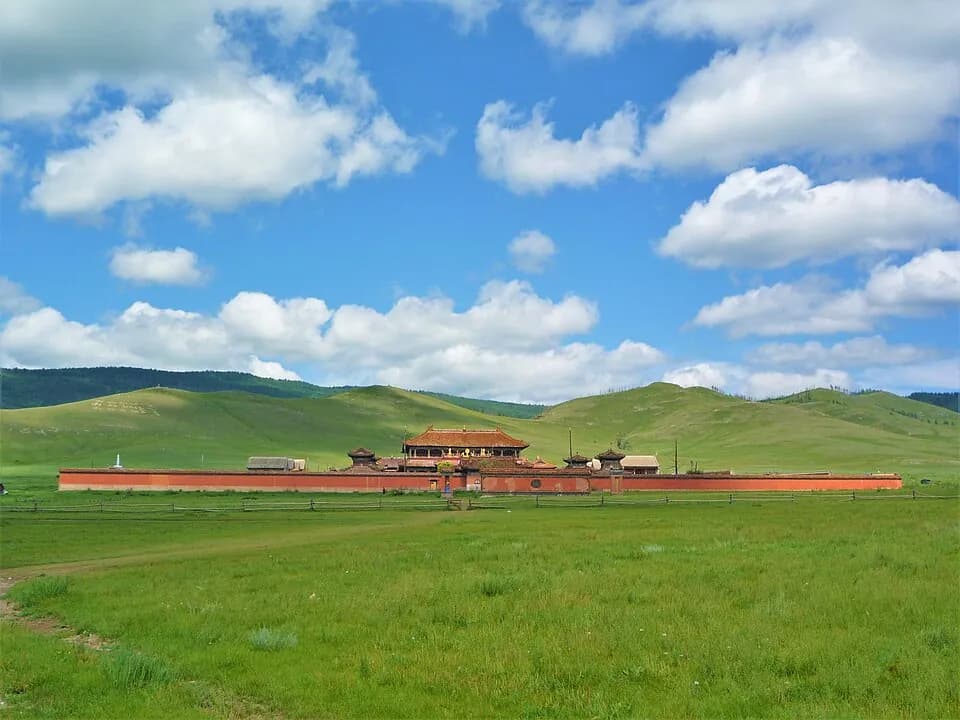
Amarbayasgalant Monastery
An 18th-century Qing-era monastery built for Zanabazar in the remote Iven valley of Selenge.
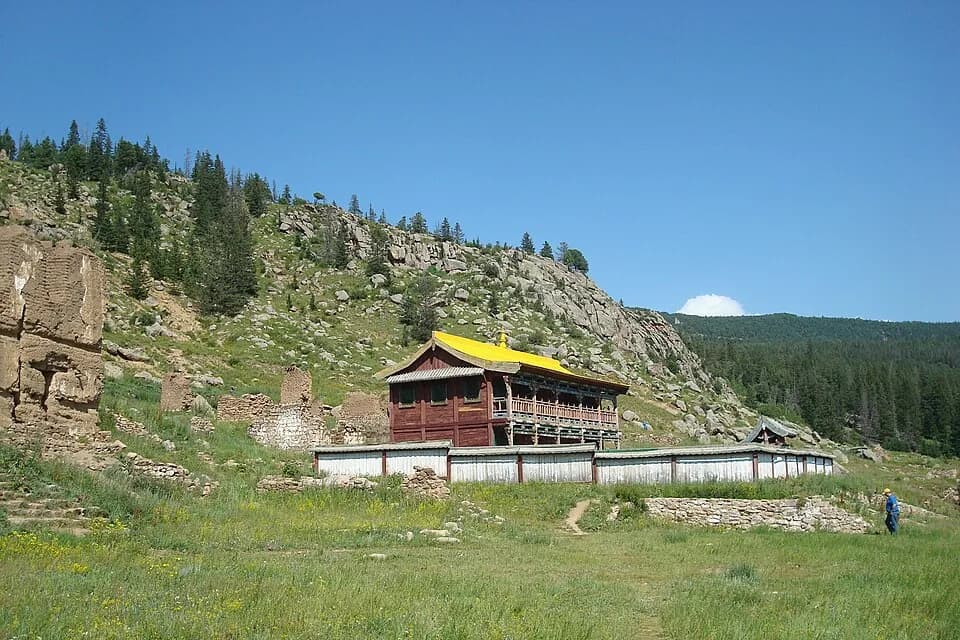
Manzushir Monastery
Ruins of an 18th-century monastery in the forest on the south side of Bogd Khan Uul, near Zuunmod.