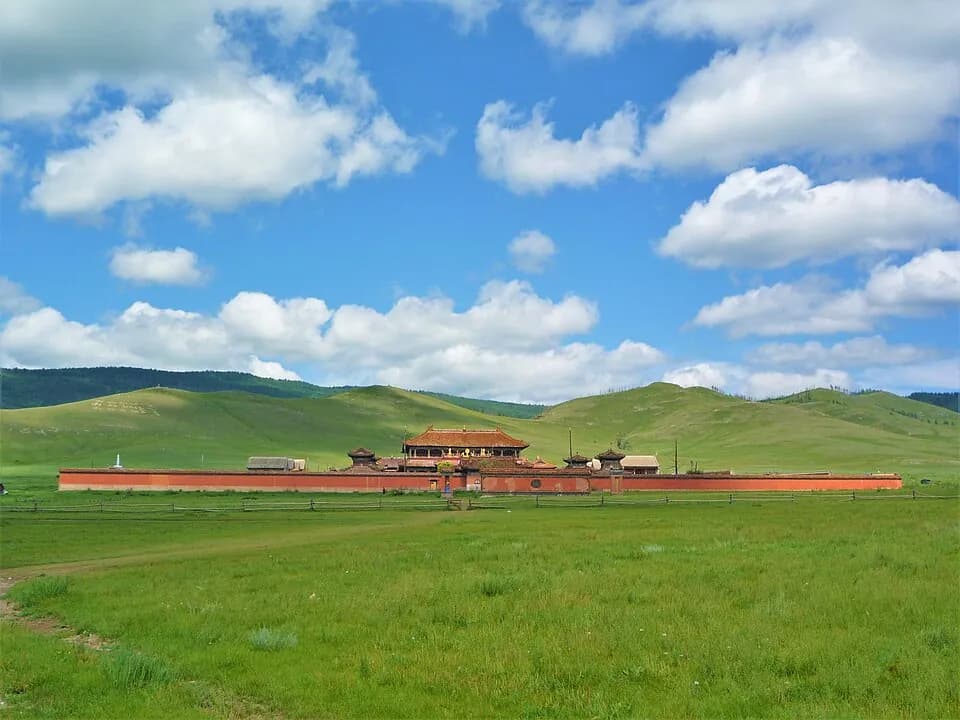
An 18th-century Qing-era monastery built for Zanabazar in the remote Iven valley of Selenge.
Amarbayasgalant Monastery stands on its own in the broad, grassy Iven valley of Selenge aimag, at the foot of Mount Büren-Khaan and about 120 km north-east of Erdenet. Built between 1727 and 1736 as the resting place of Zanabazar, it is one of the largest monastery complexes in Mongolia, with 28 of its buildings still standing. The monastery and its surrounding landscape are on Mongolia's Tentative List for UNESCO World Heritage status.
The setting
The Iven valley lies in the forest steppe of northern Mongolia, where open grassland on the valley floor gives way to forested hills, and herding families graze their animals right up to the monastery walls. The complex is laid out symmetrically on a north-south axis inside a walled enclosure, with Chinese-style halls and tiled roofs. On the hill behind are two newer monuments, a large stupa and a golden Buddha statue. From there the whole plan of courtyards, gates and halls is laid out below you.
Visiting respectfully
Amarbayasgalant is an active monastery with resident monks. If chanting is under way, you can sit quietly at the back of the hall. Walk clockwise around temples, stupas and prayer wheels, keep your voice low, do not point your feet at statues or touch sacred objects, and ask before photographing monks, worshippers or the interiors of the halls. Cover your shoulders and knees.
When to go and how long
Late May to early October is the easiest time. Summer gives the most reliable access and the greenest valley, though rain can turn the dirt approach to mud, while spring and autumn are colder and less predictable. Allow two to three hours for the temples and the walk up the hill, and stay a night nearby to see the valley at dusk and dawn, after the day visitors have left. In mid-August the annual ceremony draws large crowds.
Photo: Bogomolov.PL · Public domain · Wikimedia Commons
History
The history of Amarbayasgalant Monastery
Built for Zanabazar
Zanabazar (1635–1723), the first Jebtsundamba Khutuktu, was the leading figure of Mongolian Buddhism and a celebrated sculptor. After his death the Qing court ordered a monastery to be built as his resting place. Construction was ordered by the Yongzheng Emperor in 1727 and completed in 1736 under the Qianlong Emperor. The monastery was dedicated to Maitreya, Zanabazar's main tutelary deity, and his remains were transferred here in 1779.
Architecture
The complex is mainly Chinese in style, with Mongol and Tibetan influences. Its main temples are laid out symmetrically along a north–south axis, with secondary buildings on parallel side axes. It originally had more than 40 temples.
Purges and revival
During the anti-religious purges of 1937 many monks were executed and statues, thangkas and books were looted. The monastery partly escaped destruction: the buildings of the central section survived, and 28 structures remain today. After decades of neglect, restoration began in 1988 with funding from UNESCO and private donors, and new statues were commissioned in New Delhi. Monks have returned, and the monastery is again a place of pilgrimage.
Things to do at Amarbayasgalant Monastery
5 activities · best season: Spring, Summer, Autumn
Culture · 2 h
Tour the temple courtyards
Walk through the walled complex along its north–south axis, visit the main halls and, if a ceremony is on, listen to the monks chanting. Dress modestly and ask before taking photos inside.
History · 1 h
Learn about Zanabazar
The monastery was built as Zanabazar's resting place. Look for the Qing-era architecture and the restored statues and halls that survived the 1937 purges.
Hiking · 1–2 h
Walk above the monastery
Climb the slope behind the monastery for a view over the roofs and the Iven valley. Allow extra time and wear proper shoes.
Read the guide →Culture · 1 day
Time your visit for the August ceremony
A major annual ceremony connected with the Gongor protector deity is held in mid-August and draws pilgrims from around the country. Dates change each year, so check before planning around it.
Stargazing · Evening
Night sky over the Iven valley
Away from towns, the valley is dark at night. Stay over in a nearby ger camp to see the stars and the monastery at dawn.
When to go & how to get there
Weather by month
Getting there
The monastery is about 360 km from Ulaanbaatar by road. Drive north on the paved road towards Darkhan and Erdenet, then leave the main road for the final unpaved stretch through the countryside, which can be muddy after rain; a high-clearance vehicle is best. Allow roughly 5–7 hours each way. Another option is the train from Ulaanbaatar to Darkhan followed by a drive of about two and a half hours.
Where to stay
A few simple ger camps operate near the monastery, and camping in the valley is possible. Facilities are basic, so bring cash, snacks and a power bank. Many visitors spend one night here to see the monastery in the evening and early morning.
Gallery
4 photos · tap to enlarge · sources credited on each photo
Where is Amarbayasgalant Monastery?
from Ulaanbaatar from Darkhan · a dotted end marks a stretch with no road
Selenge province · nearest town: Baruunbüren soum
Guides that mention Amarbayasgalant Monastery
Central
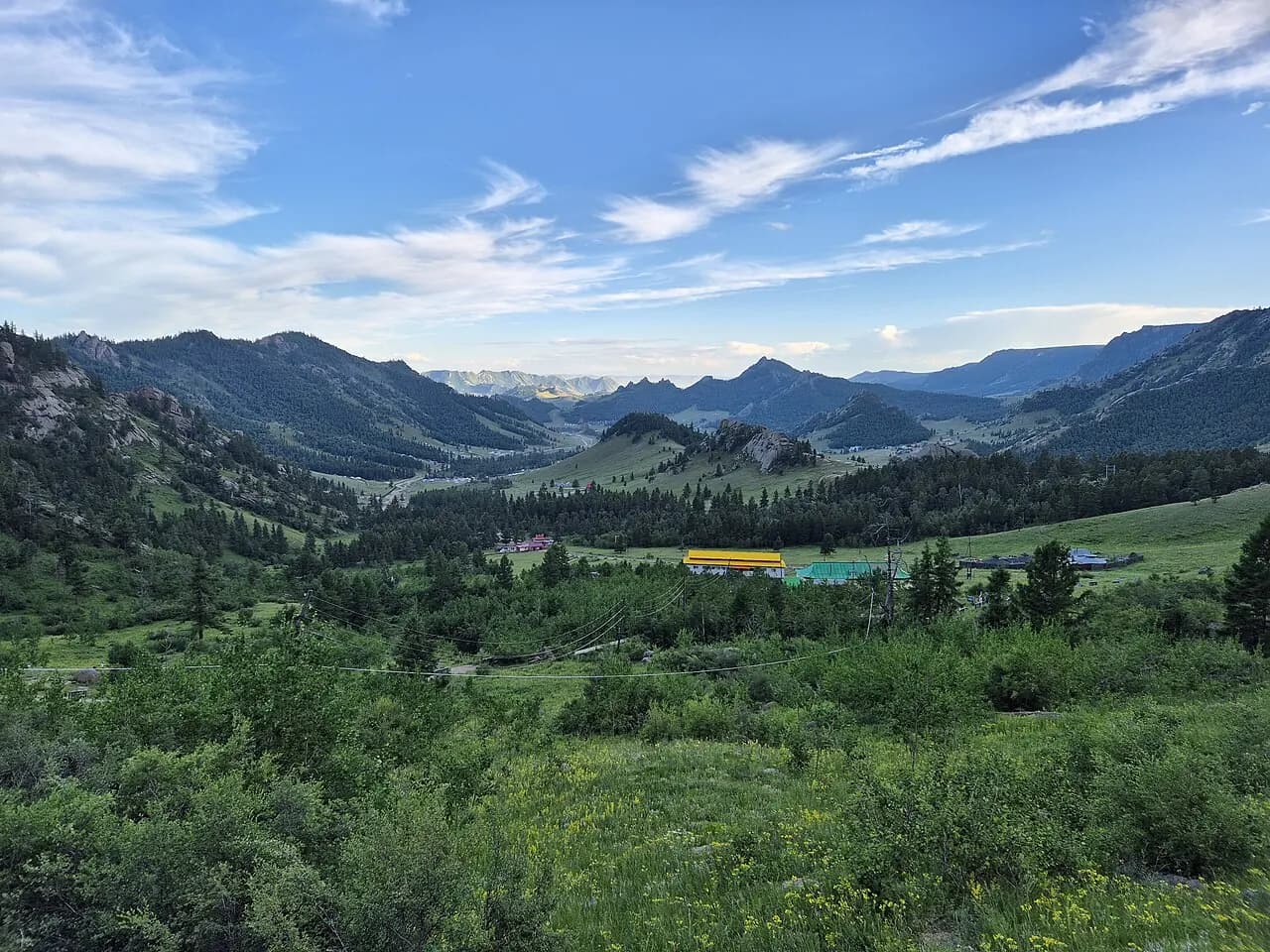
Gorkhi-Terelj
Rocks, forests and ger camps 1.5 hours from the capital.
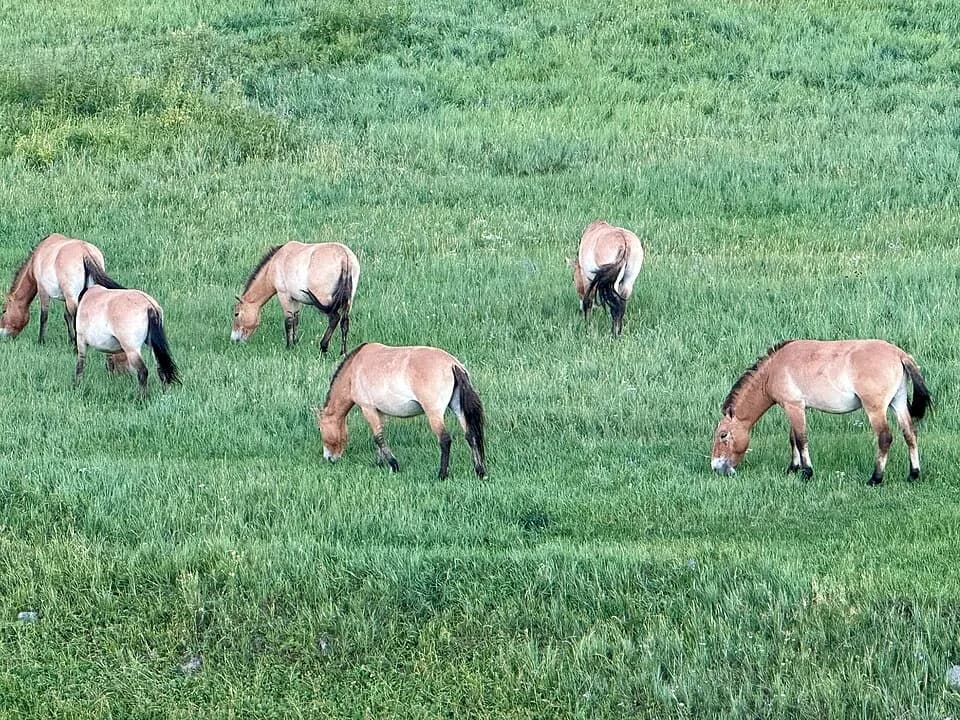
Khustai National Park
Steppe and birch-covered hills west of Ulaanbaatar where wild takhi horses were returned to Mongolia.
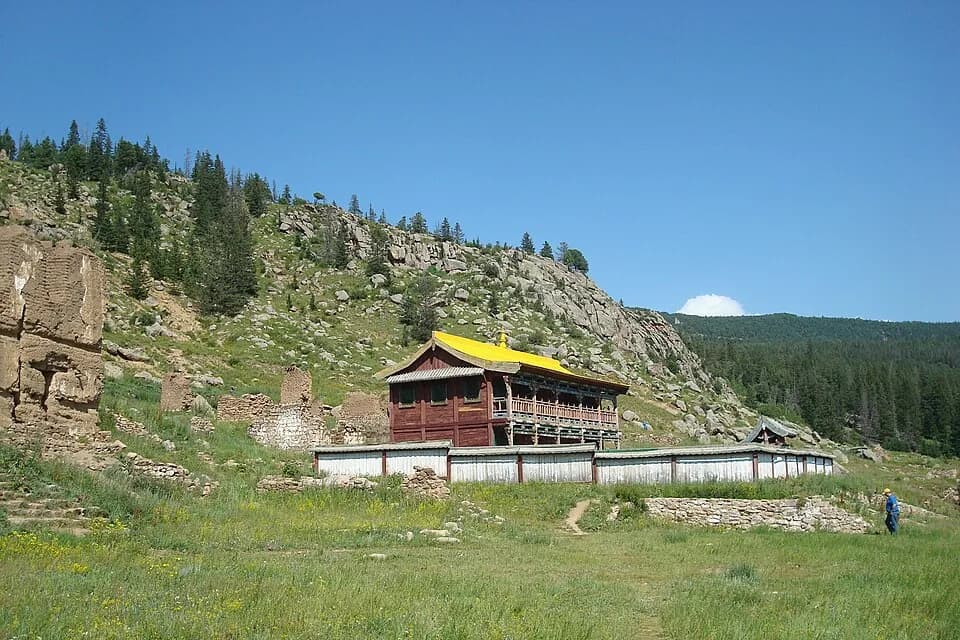
Manzushir Monastery
Ruins of an 18th-century monastery in the forest on the south side of Bogd Khan Uul, near Zuunmod.