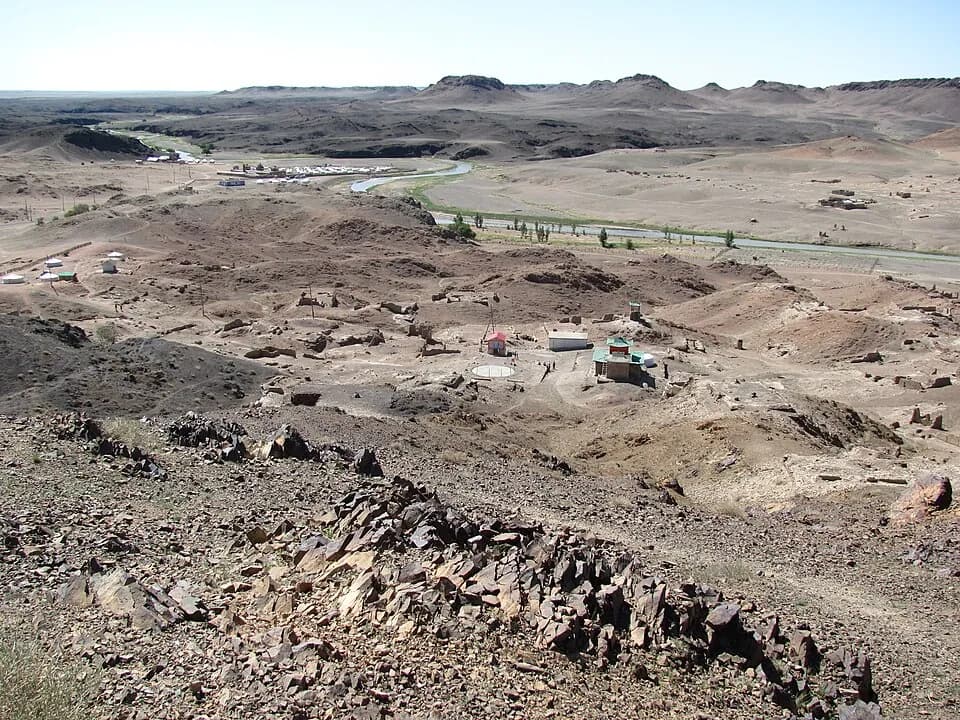
Ruins of two large monasteries facing each other across the Ongi River in the dry Dundgovi steppe.
The ruins of Ongi Monastery (Ongiin Khiid) lie on both banks of the Ongi River about 18 km south of Saikhan-Ovoo in Dundgovi, where the dry steppe begins to give way to the Gobi. Founded in 1660 and destroyed in 1939, the two complexes are now mostly foundations, broken walls and stupa bases, with one rebuilt temple and a small museum in a ger.
The river and the land
The Ongi rises on the south-eastern slopes of the Khangai Mountains and runs about 435 km south through Arvaikheer into a closed basin with no outlet to the sea. In wet years it once reached Ulaan Nuur in Ömnögovi, but in most years it now dries up before then, so at the monastery you may find a flowing stream, a dry bed or, in winter, ice. Around the ruins the land is semi-desert steppe of low hills, sand and gravel, with the river bed as the only strip of greener ground.
Exploring the ruins
Allow two to three hours to walk both banks. The complex on the far bank can only be reached on foot when the water is low or frozen, so check the crossing before setting out. The old walls are built of earth, brick and stone and crumble easily: do not climb on them or move stones, and leave any fragments where they lie. Walk clockwise around the rebuilt temple and the white stupa.
When to go
May to September is the usual season. Days from June to August can be hot with little shade, so carry water, a hat and sun cream. Spring is often windy and dusty. September and early October bring mild days, clear air and cold nights. Most visitors spend one night here on the way between Baga Gazriin Chuluu and the southern Gobi.
Photo: Torbenbrinker · CC BY-SA 3.0 · Wikimedia Commons
History
The history of Ongi Monastery
Two monasteries on the Ongi
Ongi Monastery was founded in 1660 and grew into two complexes facing each other across the Ongi River. Khutagt Monastery on the south bank was the older of the two, with eleven temples. Barlim Monastery on the north bank was built in the 18th century and had seventeen temples. At its height the complex housed more than 1,000 monks.
Destruction
In 1939, during the anti-religious purges under Khorloogiin Choibalsan, both complexes were completely destroyed and more than 200 monks were killed.
A river under pressure
The Ongi River rises in the Khangai Mountains and runs about 435 km south into the Gobi. Mining in its basin reduced its flow and damaged the water, and in many years it now dries up before reaching its end at Ulaan Nuur. A local campaign, the Ongi River Basin Movement, led to 35 of the 37 mining operations in the basin stopping work.
Rebuilding
After the end of the communist period, rebuilding at the site was decided in the 1990s. The first new temple was inaugurated in 2004, and a small museum in a ger displays objects recovered from the old monastery.
Things to do at Ongi Monastery
5 activities · best season: Spring, Summer, Autumn
History · 2–3 h
Walk the ruins
Explore the foundations, broken walls and stupa bases of both complexes on either side of the river and picture the scale of the monastery before 1939.
Culture · 30 min
Visit the rebuilt temple
See the temple rebuilt in the 2000s and the white stupa, the main standing structures at the site. Walk clockwise around them, as Buddhist custom asks.
Museum · 30 min
See the ger museum
A small museum in a ger near the rebuilt temple shows religious objects and fragments from the original monastery.
Photography · 1 h
Photograph the river valley
Late afternoon light on the ruins and the low hills of the Ongi valley makes for good photographs.
Stargazing · Evening
Gobi night sky
There is almost no light pollution here. Stay overnight at a nearby camp to see the Milky Way on clear nights.
When to go & how to get there
Weather by month
Getting there
Ongi Monastery lies about 18 km south of Saikhan-Ovoo in Dundgovi, roughly 450 km from Ulaanbaatar by road. The usual route follows the paved road south to Mandalgovi and continues west on long unpaved stretches; the final approach is on dirt tracks, and a high-clearance 4x4 is recommended. Public buses reach Mandalgovi, but there is no public transport to the site. Ongi is often combined with Baga Gazriin Chuluu, Tsagaan Suvarga, Bayanzag and Kharkhorin on Gobi routes.
Where to stay
A few ger camps operate near the ruins, with basic beds, simple meals and variable electricity and hot water. Camping in the valley is also possible. Bring cash, extra water and a power bank.
Where is Ongi Monastery?
from Ulaanbaatar from Arvaikheer · a dotted end marks a stretch with no road
Dundgovi province · nearest town: Saikhan-Ovoo soum
Guides that mention Ongi Monastery
Gobi
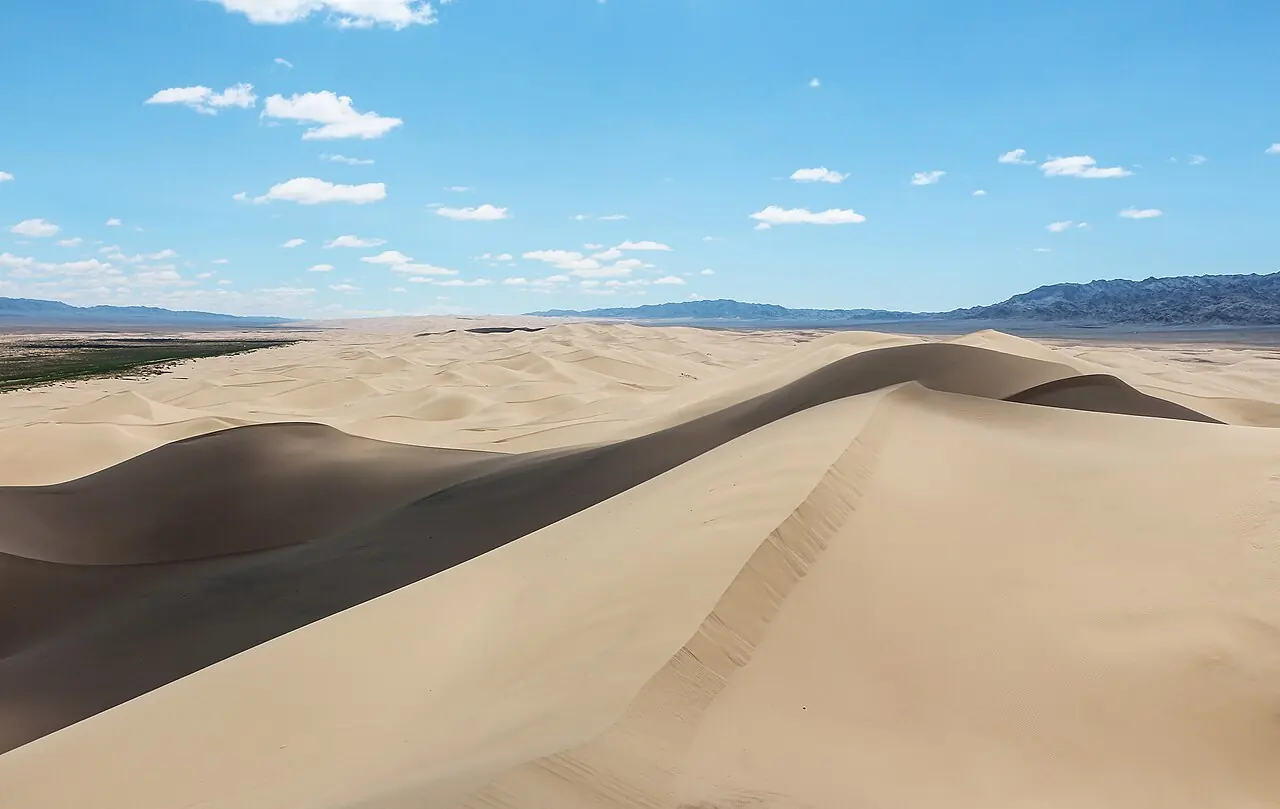
Khongoryn Els
The 'singing sands': one of Mongolia's largest dune fields, with ridges said to reach 300 m.
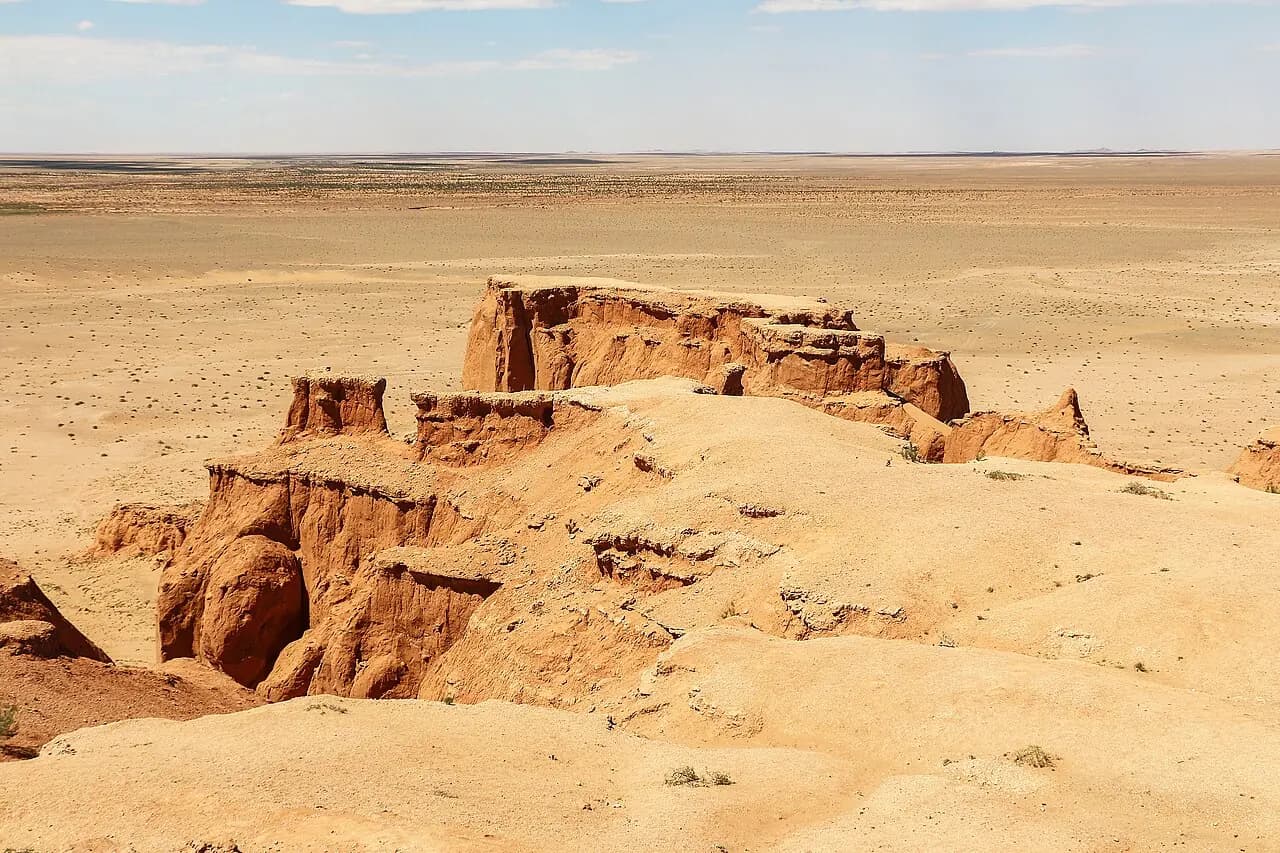
Bayanzag (Flaming Cliffs)
The red cliffs where dinosaur eggs were first discovered.
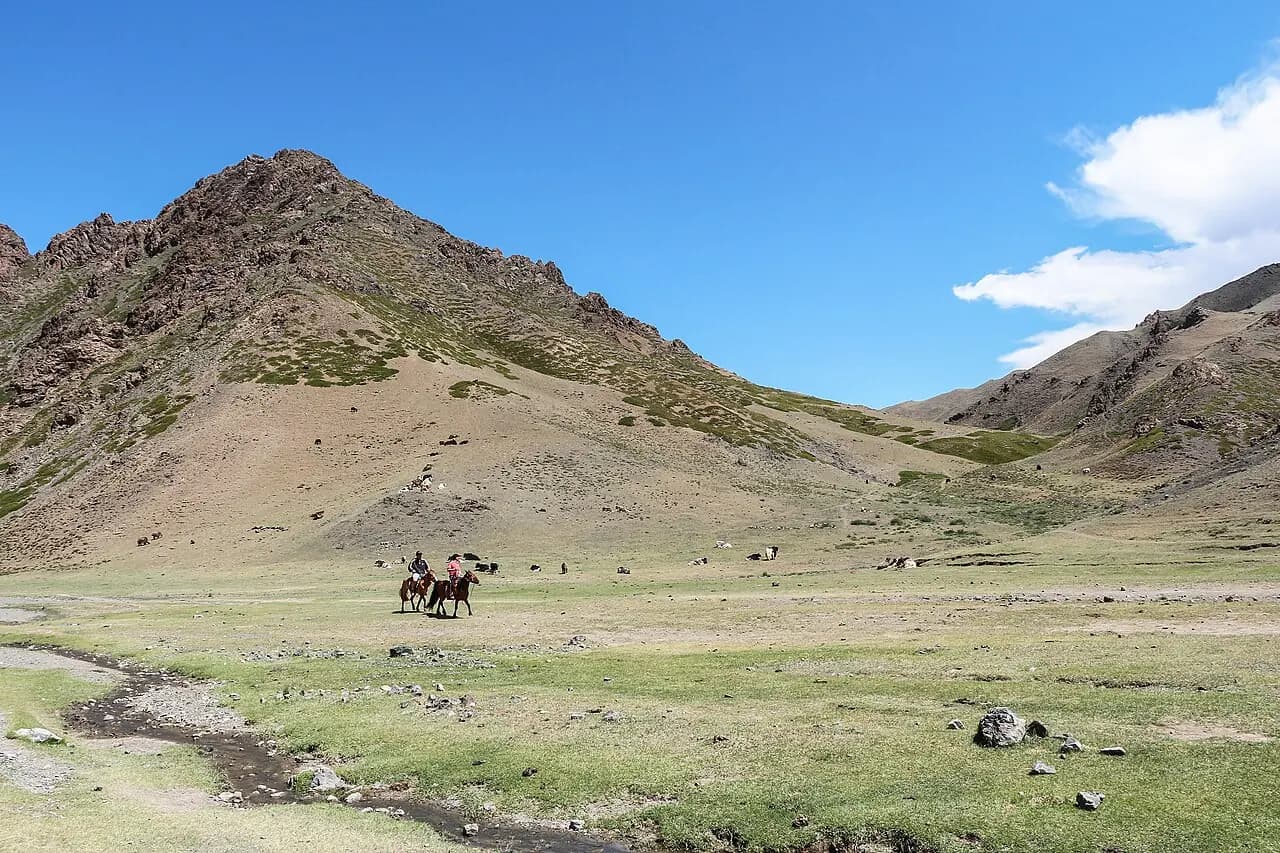
Yolyn Am
An ice-filled gorge in the heart of the Gobi; the ice survives into midsummer.