Mongolia Facts
Key Mongolia facts for travellers: area, population of about 3.5 million, capital, language, currency, time zone, climate and what surprises visitors.
3 min read · Updated

Photo by Altai Baatarkhuu on Unsplash
Mongolia is a landlocked country in East-Central Asia, bordered by Russia to the north and China to the south. It covers about 1.56 million square kilometres but has only about 3.5 million people (2024), making it the most sparsely populated sovereign country in the world. Roughly half of all Mongolians live in the capital, Ulaanbaatar.
Mongolia at a glance
- Official name: Mongolia (Монгол Улс)
- Capital: Ulaanbaatar
- Area: about 1,564,000 km², the second-largest landlocked country after Kazakhstan
- Population: about 3.5 million (2024)
- Language: Mongolian, written in Cyrillic; the traditional vertical Mongolian script is taught in schools and increasingly used in official documents
- Currency: Mongolian tögrög (MNT, ₮)
- Time zone: UTC+8 for most of the country; the far western provinces use UTC+7
- Government: parliamentary republic with a directly elected president
- Administrative divisions: 21 provinces (aimags) plus the capital city
People, language and religion
Most Mongolians belong to the Khalkha group. The country is also home to Kazakhs in the far west (mainly in Bayan-Ölgii province), Buryats in the north, Oirat groups such as the Dörvöd and Torguud in the west, and other communities. Mongolian is spoken nationwide, and Kazakh is widely used in Bayan-Ölgii. Many older people speak Russian, while English is increasingly common among younger people in Ulaanbaatar but rare in the countryside.
Tibetan-tradition Buddhism is the main religion. Shamanic practices remain important to many families, Islam is practised mainly by Kazakhs, Christianity has a small following, and a large share of people report no religion.
Land, climate and the herding way of life
Mongolia is a high country, with an average elevation of around 1,500 metres. Landscapes range from the Altai Mountains in the west and the forested north around Lake Khövsgöl to the open steppe of the centre and east and the Gobi Desert in the south. The climate is sharply continental: winter nights regularly fall below −30 °C, while Gobi summer days can top 35 °C. Clear, sunny days are so common that Mongolia is often called the "Land of the Eternal Blue Sky".
Livestock herding remains central to life outside the cities. Mongolians speak of the "five snouts" — horses, cattle (including yaks), camels, sheep and goats — and the national herd numbers in the tens of millions, many times the human population. Many families, including a large part of Ulaanbaatar's residents in the ger districts, still live in a ger, the round felt tent.
Things that surprise first-time visitors
- Ulaanbaatar is often described as the coldest national capital in the world, with an average annual temperature close to 0 °C.
- Distances are huge and paved roads are limited. Many routes between towns are still dirt tracks, so a 300 km journey can take most of a day.
- Mongolians usually go by a patronymic (their father's name) followed by their given name — Batyn Dorj means Dorj, child of Bat — and people are addressed by their given name.
- The biggest celebrations are Tsagaan Sar, the lunar new year in winter, and Naadam, the national festival held on 11–13 July with wrestling, horse racing and archery.
Practical tips
- Check entry requirements before you travel. Visa rules for Mongolia have changed several times in recent years, so confirm with the Immigration Agency of Mongolia or your nearest Mongolian embassy.
- Carry cash in tögrög for the countryside. Cards are widely accepted in Ulaanbaatar but not always elsewhere.
- Power sockets are mostly the European two-pin type (types C and E) at 230 V.
- Learn a few words: "Sain baina uu" (hello) and "Bayarlalaa" (thank you) are always appreciated.
Places in this guide
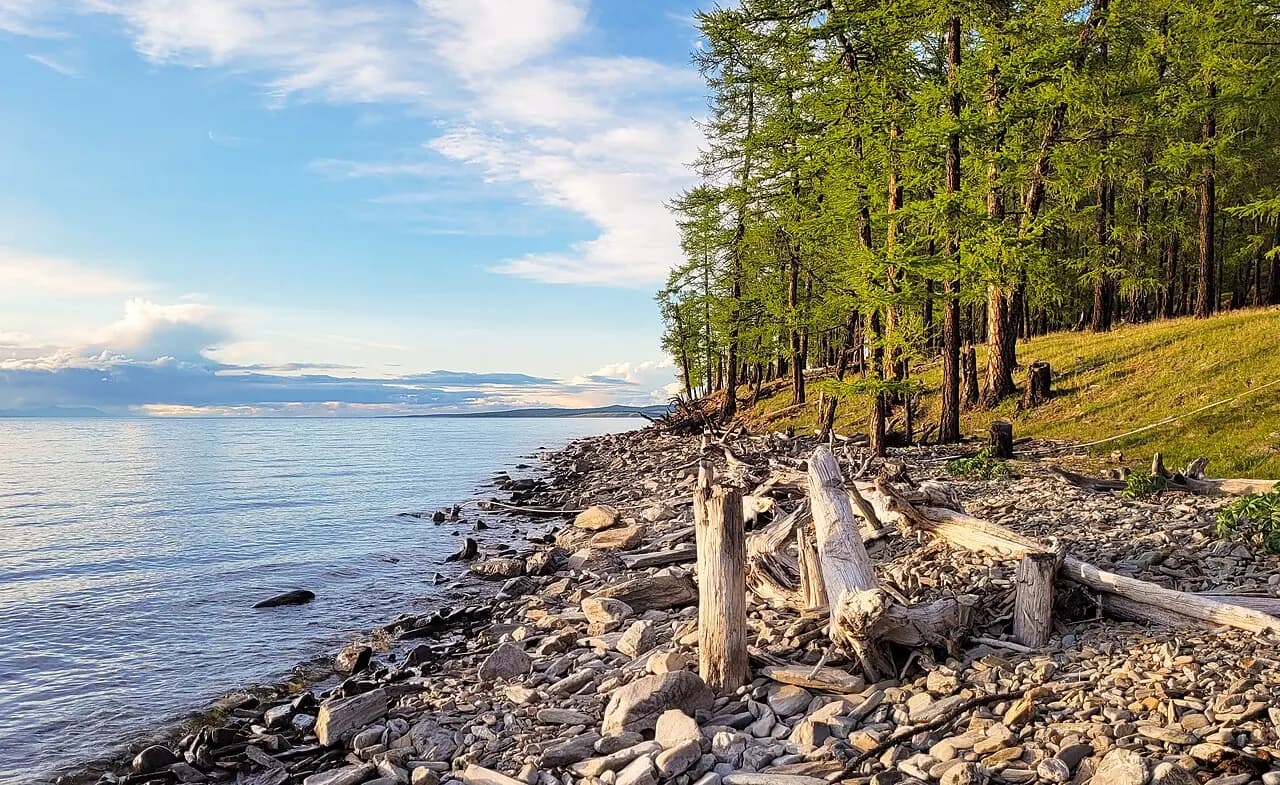
Lake Khövsgöl
The 'blue pearl of Mongolia', holding almost 70% of Mongolia's fresh water.
Frequently asked questions
What is the population of Mongolia?
Mongolia has about 3.5 million people (2024), roughly half of whom live in Ulaanbaatar. That makes it the most sparsely populated sovereign country in the world.
What language is spoken in Mongolia?
The official language is Mongolian, written in the Cyrillic alphabet. Kazakh is widely spoken in the far west, and English is increasingly spoken by young people in Ulaanbaatar.
What currency does Mongolia use?
Mongolia uses the tögrög (MNT, ₮). Cards are common in Ulaanbaatar, but you should carry cash when travelling in the countryside.