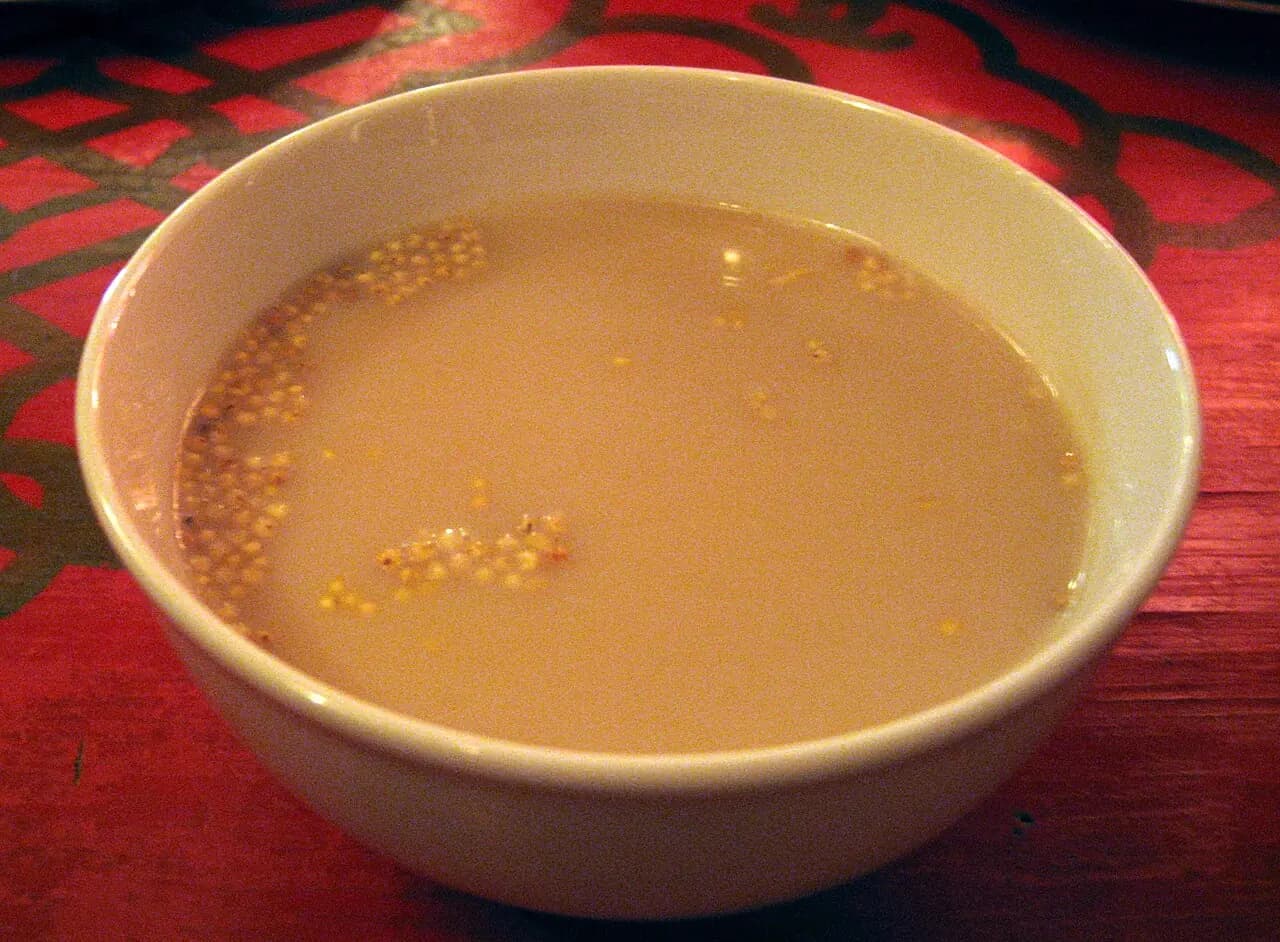
Photo: user:takoradee · GFDL · Wikimedia Commons
Drinks
Suutei tsai (milk tea)
Salted milk tea, how every day begins.
What it is
Suutei tsai is Mongolian milk tea: tea boiled with milk and usually salt. It is drunk throughout the day, with meals and between them, and it is the first thing offered to a visitor in a ger. To newcomers the salt can be a surprise, since the drink tastes more like a light broth than a sweet milky tea, but for most Mongolians it is the taste of home.
The tea traditionally comes from compressed bricks of lower-grade leaves and stems, with pieces chipped off as needed. Tea bricks travelled to Mongolia along caravan routes from China and were once valuable enough to serve as a form of currency.
How it is made
Tea is boiled in water, milk is added (from cows today in most places, but also from yaks, sheep, goats or camels), and salt goes in to taste. The traditional finishing step is to scoop up the tea with a ladle and pour it back from a height again and again, which mixes and aerates it. Many households now skip this step or make tea in a thermos.
Additions change from family to family and region to region. Toasted millet, a spoonful of butter or shar tos, öröm, rice, dried meat or small dumplings may all be added; the version with dumplings is known as banshtai tsai. Salt levels vary too, and in some areas tea is drunk with little or no salt.
When and where to try it
Everywhere. Families brew a pot each morning, and in many homes the woman of the household flicks the first ladle of fresh tea upwards as an offering to the sky, the spirits of the land and revered mountains. Some urban families do this from their balconies. Guanz canteens serve it with buuz and khuushuur, and instant milk-tea sachets are sold across the country. Tea is usually served at the start of a meal, with boortsog and aaruul on the table.
Etiquette and tips
- In a ger, the first bowl traditionally goes to the head of the household and then to others in order of seniority.
- Accept the bowl with both hands, or with your right hand supported at the elbow by your left. Keep your sleeves rolled down.
- Drink at least a little. If you do not like it, touching the bowl to your lips and setting it down is polite.
- Mongolians traditionally preferred milk drinks to plain water, an observation made by the travelling friar William of Rubruck in the thirteenth century.
- Ingredients
- Brick tea, milk, salt
- How it is made
- Boil, add milk, ladle to aerate.
- Health & season
- All year. · Winter, Spring, Summer, Autumn
- Famous in
- Central, Khangai & Central, Gobi, Eastern Mongolia, Western Mongolia
Photo: user:takoradee · GFDL · Wikimedia Commons
Where to eat real Mongolian food in Ulaanbaatar